Arjuna accepts Krishna's command
Bhagavad GitaArjuna accepts Krishna's command at the end of the Krishna–Arjuna Dialogue, when a warrior who had laid down the Gandiva has recovered the clarity to act. His acceptance is decisive not because it erases the moral horror of the battle, but because it changes the basis of his action: he no longer treats victory, sovereignty, pleasure, or personal attachment as sufficient reasons to fight, and instead submits his decision to the teaching of Krishna, his charioteer and spiritual guide.
Crisis Before the Decision
The command becomes necessary because Arjuna's first response to the Battle of Kurukshetra is refusal. He asks Krishna to place Arjuna's chariot between the two armies so that he may inspect those with whom he must contend. Once he sees fathers, grandfathers, teachers, sons, relatives, friends, and well-wishers standing on both sides, the prospective battle ceases to appear as an abstract contest between armies. It becomes a conflict among people bound to him by family, instruction, affection, and obligation.
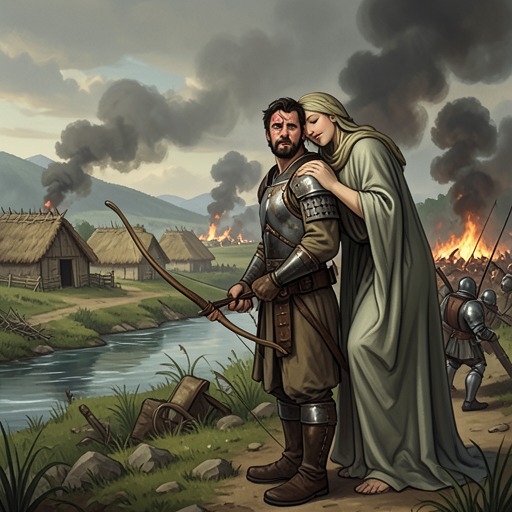
His physical distress expresses the force of that recognition. His limbs grow languid, his mouth becomes dry, his body trembles, his hair stands on end, his skin burns, and the Gandiva slips from his hand. He declares that he does not desire victory, sovereignty, or pleasures when the very people for whose sake those things would be desired are prepared to die. The scale of the possible reward cannot compensate for the destruction of the human relationships that give the reward meaning.
Arjuna then extends his objection from personal grief to a theory of social and religious catastrophe. He fears that killing his kinsmen will destroy family customs, overpower the race with sin, corrupt its women, produce an intermingling of castes, interrupt rites for ancestors, and lead both the destroyers and the destroyed race toward Hell. Even if the opposing side is morally corrupted by avarice, he argues, those who understand the consequences should abstain from the same sin. He concludes that it would be better to be killed unarmed than to slay his own relatives for the sake of sovereignty.
Krishna's Reordering of Duty
Krishna rejects the paralysis of this compassion as an unworthy weakness at the moment of crisis and commands Arjuna to rise. The instruction does not simply appeal to courage or ambition. It develops a larger account of action in which no embodied person can remain entirely without work, inaction cannot by itself produce emancipation, and action becomes spiritually liberating when performed without attachment to its fruits.
Krishna distinguishes the discipline of knowledge from the discipline of work, but denies that this distinction permits Arjuna to escape action. Work is better than inaction, and the body itself cannot be sustained without it. Action performed for sacrifice does not bind the actor in the same way as action performed for private gain. Krishna therefore directs Arjuna to devote his work to him, to act without desire and affection, and to engage in battle with his weakness dispelled.
This teaching also establishes a standard for judging action. The wise person acts without attachment, not because action is meaningless, but because action must be aligned with one's own duty. Even an imperfectly performed own duty is better than another's duty performed well; death in the performance of one's own duty is preferable, whereas adopting another's duty carries fear. For Arjuna, the battlefield decision is consequently recast as a test of Svadharma rather than a choice between personal preference and impersonal violence.
From Emotional Turmoil to Discernment
The acceptance depends on a transformation of mind as much as on a conclusion about duty. Krishna describes the steady-minded person as one who casts off desires, remains unagitated amid calamities, is free from attachment, fear, and wrath, and neither exults nor recoils when agreeable or disagreeable objects appear. The senses must be restrained, because attention to sense objects breeds attachment, attachment breeds wrath, wrath destroys discrimination, and the collapse of discrimination ends in ruin.
The discipline demanded of Arjuna is therefore active inward control. Krishna compares the disciplined devotee to a lamp in a windless spot: the mind, no longer blown about by desire and aversion, can remain fixed. Through practice, restraint, meditation, and direction of thought toward the self, the restless mind may become tranquil. The resulting equanimity is not indifference to all distinctions; it is the capacity to see the self in all creatures and all creatures in the self, regarding the happiness and misery of others as one's own.
This inward reorientation gives Arjuna a way to act without making personal gain the measure of action. The agent who is free from attachment, steady, energetic, and unmoved by success or defeat embodies the quality of goodness. The corresponding intellect knows action and inaction, what ought and ought not to be done, fear and fearlessness, bondage and deliverance. Arjuna's final decision thus represents recovered discernment rather than a simple surrender to command.
The Command and the Instrument
The most severe form of Krishna's instruction appears in the revelation of the Vishvarupa. Arjuna sees warriors entering Krishna's terrible mouths, rushing toward destruction like rivers flowing into the ocean or moths flying into a blazing fire. Krishna identifies himself as Death, the destroyer of the worlds, already engaged in slaying the human race, and tells Arjuna that the warriors in the opposing divisions will cease to exist without him. Drona, Bhishma, Jayadratha, Karna, and other heroic warriors are declared already slain by Krishna; Arjuna is told to become merely the instrument, to rise, gain glory, vanquish the foe, and enjoy the kingdom.
This declaration alters Arjuna's understanding of agency. He is not presented as the independent author of the entire destruction, nor is he invited to act from hatred or appetite. His responsibility is to perform the action assigned to his nature and duty while surrendering attachment to the result. The command therefore combines inevitability with obligation: the larger destruction is already encompassed by Krishna's cosmic action, but Arjuna must still choose whether to fulfill his role within it.
The revelation overwhelms him. Trembling, with joined hands, a voice choked by fear, and repeated salutations, he acknowledges Krishna as the refuge of the universe and as the supreme, indestructible reality. The scene makes acceptance costly rather than casual. Arjuna does not reach his decision by reducing Krishna to an ordinary adviser; he submits after confronting a form that makes ordinary human measures of victory, kinship, and individual power appear radically incomplete.
Acceptance and Its Consequences
Near the close of the teaching, Krishna combines freedom and command. He tells Arjuna to reflect fully and then act as he chooses, yet also urges him to set his heart on Krishna, become his devotee, sacrifice to him, and bow down to him. Krishna promises deliverance from sin to one who takes him as the sole refuge and asks Arjuna not to grieve. The command is therefore framed as the culmination of persuasion, revelation, devotion, and discernment rather than as a bare military order.
Krishna further warns that self-conceit cannot make Arjuna escape his nature. If Arjuna thinks, "I will not fight," that resolution will be vain, because Nature will constrain him and his own duty will compel the action he refuses. Krishna then places the Lord in the heart of every being, turning beings as if mounted on a machine through divine illusion, and directs Arjuna to seek shelter there. The choice to fight is consequently presented as the recognition of an order already operating through him.
Arjuna's response is explicit: his delusion has been destroyed, his recollection has been regained through Krishna's favour, his doubts have been dispelled, and he is now firm. He concludes, "I will do thy bidding." This is the decisive change from the opening of the dialogue, when he asked Krishna to position the chariot, declared that he would not fight, and remained silent. The bow that had slipped from his hand becomes the emblem of recovered readiness, while the command he once resisted becomes the action he accepts.
Sanjaya's concluding narration gives the decision a wider significance. He repeatedly recalls the wonderful and holy conversation between Krishna and Arjuna, the revelation of Krishna's form, and the teaching heard through Vyasa's favour. In his judgment, prosperity, victory, greatness, and eternal justice belong where Krishna, the Lord of Yoga, and the great bowman Arjuna are together. Arjuna's acceptance therefore closes the dialogue by joining spiritual authority to disciplined action: the warrior returns to the field not because grief was false, but because grief has been answered by a transformed understanding of duty, agency, and devotion.